

AI + SYSTEMS FOR FUNDRAISING/DEVELOPMENT

AI is a bit of a hot topic right now in the cultural sector as we navigate emerging ethical and copyright issues. A lot of this work still needs to be resolved, but there are some uses for AI and automation in small-scale fundraising and development.
To be clear, I don’t think we’re seeing a level of AI which can simply do our fundraising for us, but there are some specific use cases where we can save ourselves some time and effort doing manual tasks.
Here are our top 5 use cases to help smaller-scale companies kickstart their fundraising efforts.
1) ChatGPT for prospecting
Prospecting funders means researching a list of funders that you might be able to ask for a grant or donation. You can do this on Google or on large funding search databases, but sometimes, these things sit behind paywalls.
If you’re new to researching funders or want to save time trawling Google, ChatGPT might have some new suggestions for you.
I started by using the prompt “Please can you give me a list of 10 funders that would give grants to a youth theatre project in Manchester. The organisation running it is a charity with a turnover of £250k. “
It’s important to say key eligibility criteria, such as the organisation being a charity and the turnover. ChatGPT doesn’t have a 100% success rate for checking these things, but if funders use the same language on their website, it can filter out a few things.
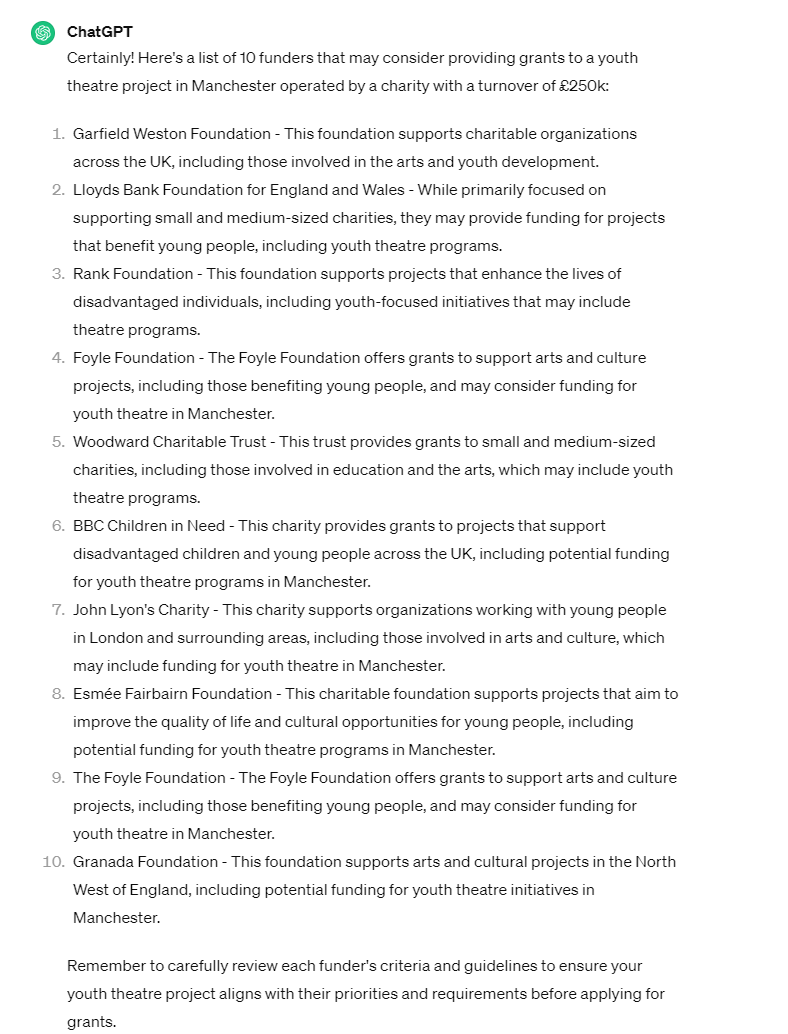
You will not be eligible for all these funders, but you might be eligible for some, and it might find some names you’ve not seen before.
If 10 is not enough, you can ask for more with prompts like “Please give me 10 more”.
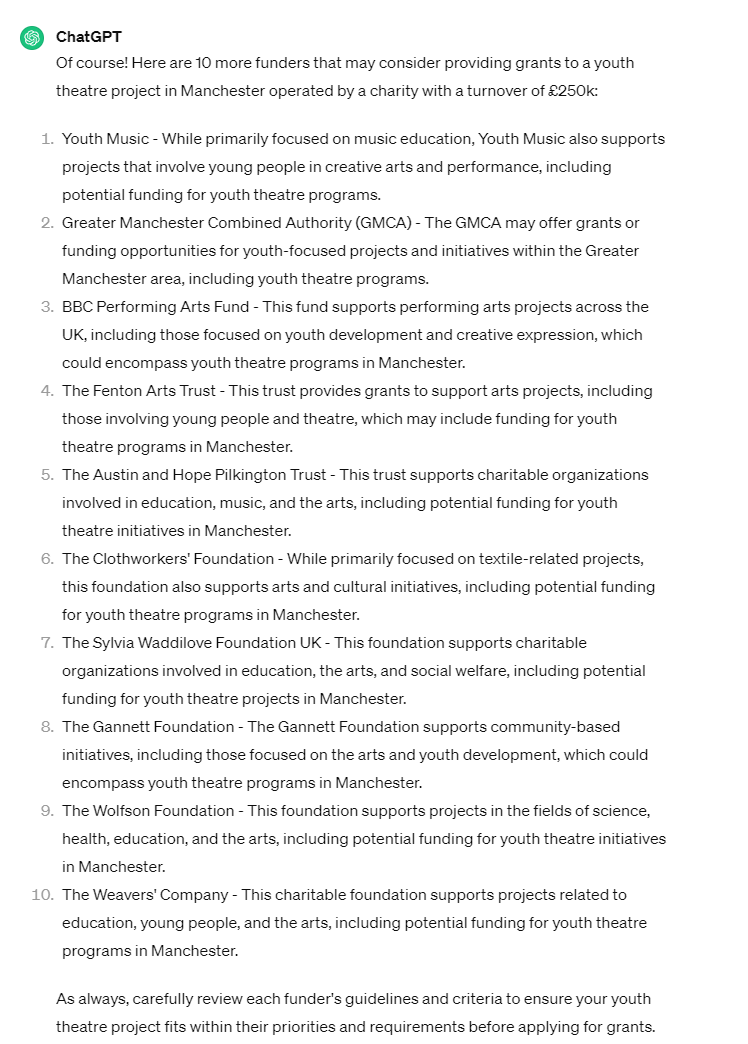
Then, to a certain extent, you can begin to target specific priorities. For example, you might want to better target grants to funders offering multi-year funding so you don’t have to re-apply yearly.
You can ask, “Which of the funders offer multi-year grants?”.
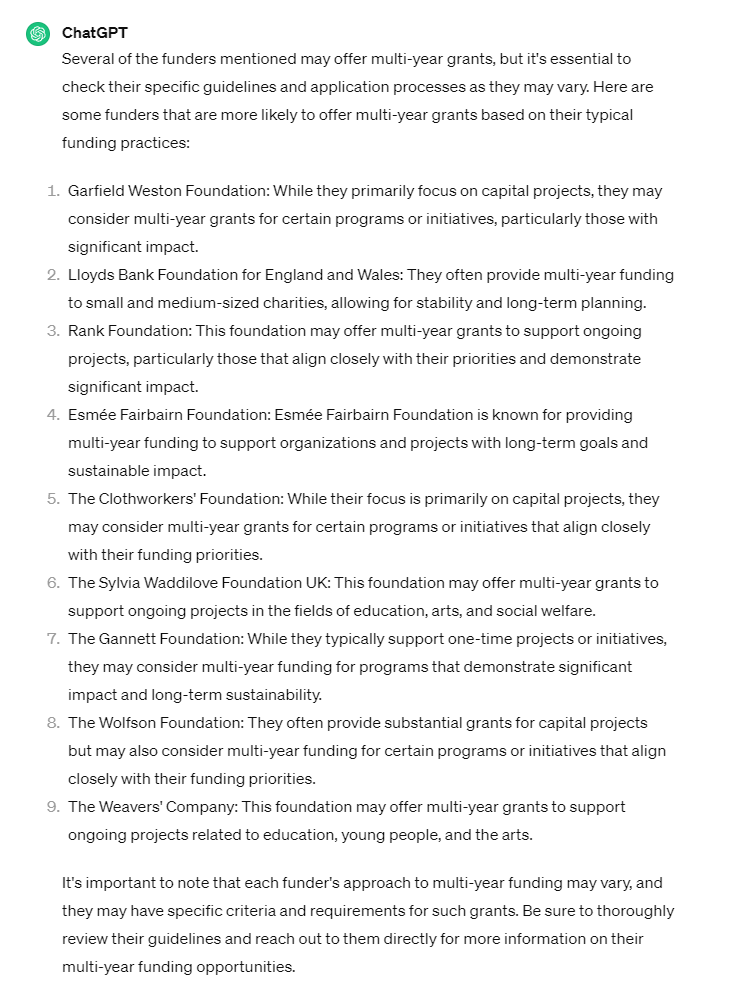
It’s still not perfect, but it is a more comprehensive search function than you will find on Google.
Hiring someone with contextual knowledge and lived experience of your focus is obviously still better if you have the resource for it, but this can help in a pinch.
2) Asana for managing your T&F pipeline
Large organisations can have huge software suites to manage their Trust & Foundation pipeline; these can often be expensive or too much for smaller organisations. We’ve built a template for managing the pipeline in Asana instead.
It’s a very low-cost task management system that is also incredibly useful for neurodivergent people to help with prioritisation and workflow management.
We use a basic setup like the one below.

We can track the names of bids, who the bid writing is assigned to, and how much they are for. Asana can calculate the total of all the bids you’re applying to in any one section so you can more quickly communicate to your trustees. You can also create small drop-downs with lists of programmes that the bid is focused on.
Once you open the task in Asana, you can also store more information.

For example you can create a custom field to track when a bid was submitted, what feedback you got from the funder if it was unsuccessful, or the number of days it took.
Yes, you can build some of these things in excel, but it is often not particularly intuitive and all the information is visible at once which can be overwhelming. In Asana you can create levels of visual information, so you can decide what you want to see.
The useful part of this is that when you need to give a fundraising report to the board, it can be pulled directly from Asana.
If a bid is successful, you can set up an automation that will remind you when you need to write reports or make new payment requests.
These kinds of fundraising processes, which are a specific list of tasks in a set order, can easily be automated to cut down on people having to constantly email new tasks.
If you want to work with a freelance bid writer, it can also cut down meetings times because you can assign new bids to them and link them to key information from when you’ve interacted with that funder before.
If you want to talk about designing a fundraising system that works for you, get in touch.
3) Can ChatGPT be used to write funding bids?
This is the top question people always ask me, and elsewhere experiments are ongoing to try and understand how the use of generative AI affects success rates with funders.
The problem with ChatGPT for me is that it is very good at emulating how information elsewhere is copied, but it’s not so good at finding original and effective ways of structuring information.
A lot of bid writing work happens before you begin writing. The first thing we often do with companies is refresh their logic model, which is a diagram that defines how they create impact and what they do. A company's list of activities can be really complex, especially in the cultural / community organising sectors, and there is a lot of work to be done bringing that into a strategic shape before you begin the linguistic articulation.
There are some things you might be able to use ChatGPT for however. If you have a body of funding bids that are written using an effective structure, and in your voice, you can upload those into ChatGPT and ask ChatGPT to analyse them for certain markers like Style, Tone and Voice.
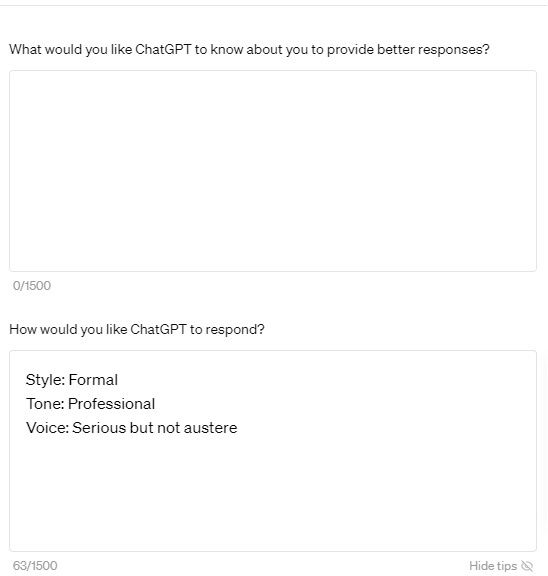
You can then add these custom markers into ChatGPT’s custom instructions so it begins to emulate your writing style.
In our opinion, ChatGPT might be able to help you create a first draft of a bid if it has read previous bids you’ve written. But then you need to continue to re-draft and adjust it yourself.
We never recommend submitting a bid written entirely by any kind of generative AI.
4) Case for Support / Research?
ChatGPT can help you do research to justify the need for your programmes.
The ideal situation is that you have researched and identified a need for a programme and are building a solution around it.
However, that need might have been identified through community consultation, and now you need statistics to back it up.
Again, ChatGPT is like a more comprehensive Google search. I asked it “I need a statistics that shows that disabled people have less access to employment in the UK. “
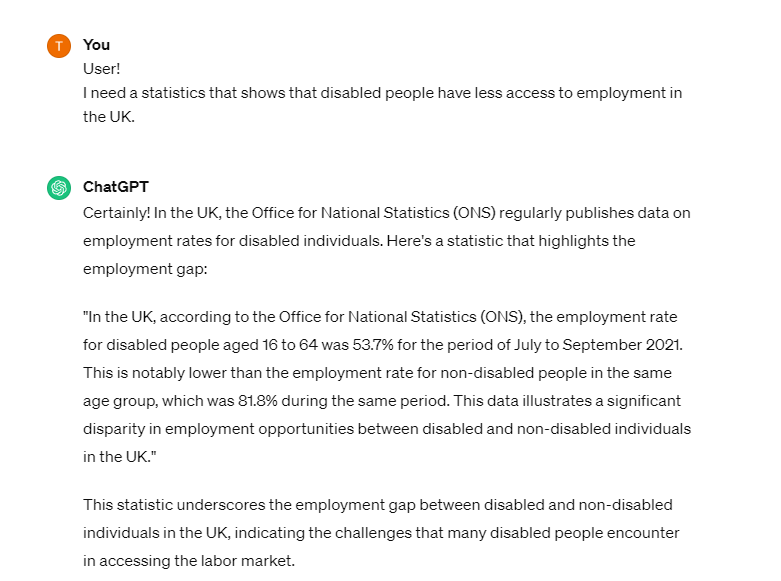
I already knew this statistic, but it pulled the quote I needed much more quickly than if I had searched through the reports myself.
5) Individual Giving & Content Generation
Sometimes it feels like all small-scale social content generation happens on Canva, I am often not sure what we did before we had it.
Canva now has a number of AI tools, and although they’re not all great, and we should be wary of how they are drawing on data from artists without their consent, some can be useful.
There are a number of apps you can now use which will take your captions for your content, and convert it into other formats for other versions of social media. For example, you can upload the text you’ve used in an instagram caption, and ask Canva to rework it to fit within the twitter word limit.
There are also apps that can help you to describe your images, and generate alt text. This should always be checked by a human, but it can help you write a first draft. I find it particularly useful because I’m colourblind, and so AI can write alt-text which describes the colours for me.
We think this use is probably limited to quite restricted use cases right now, the more creative you try to be, the more the content tends to require some kind of human intervention in the re-draft process.
But, if you’re stuck for time, this can help you with accessibility of your content and making sure you have something to engage your donors.